
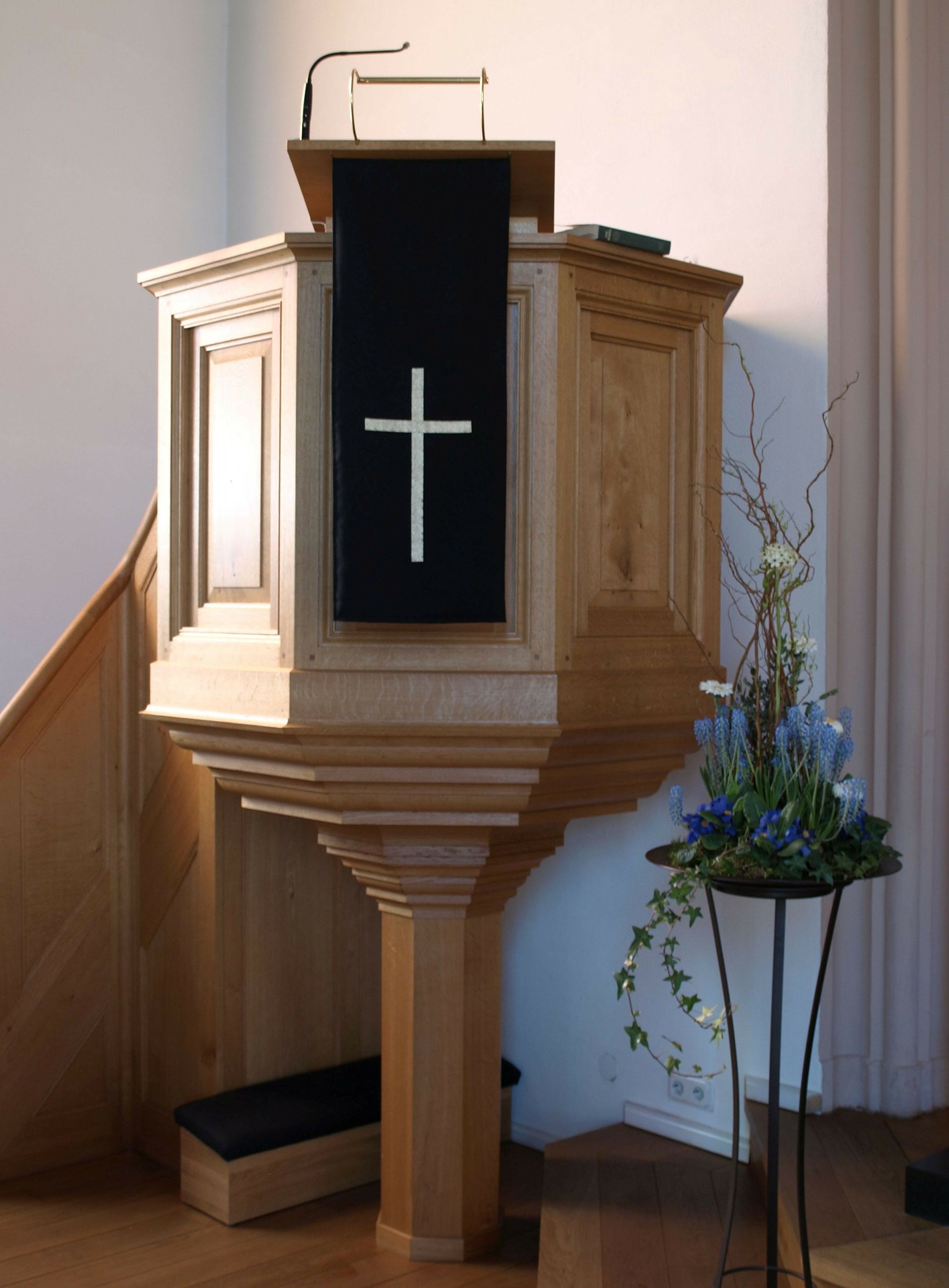
Where have all the Preachers Gone?
By J.P. Thackway


All is not well with the pulpit these days. Few would deny that preaching fails to attract and hold congregations as it once did. Apostate churches, of course, assure us that we are living in days of the audio-visual and the sound bite. People are used to seeing and experiencing information. Their concentration span cannot cope with sermons longer than five or ten minutes. What previous generations were accustomed to, ours now finds impossible.
Senses
Therefore, so the argument runs, we must give greater place to the senses. Worldly Christendom has always catered for worshippers in this way, but it has never sounded more plausible than now. On the one hand, Romanism and its offshoots provide the sights, smells and sounds of ritual. Its pageantry is alluring. The charismatics on the other hand (having the same sensual appeal) offer elated, trance-like and arm waving “worship”. In both of these, sensualism reigns and the applied preaching of objective truth has little appeal.
Changing
Even in evangelical and reformed circles, things are changing. Preoccupation with being contemporary has forced churches to reassess their historic commitment to the primacy of preaching. The increased use of music and singing, young people’s items and congregational participation leave less time for sermons. Preaching is being sidelined. Reasoning that once belonged to ritualism and charismaticism has infiltrated a
constituency that knows better.
Sign
Another sign of the times appears in a popular evangelical newspaper. Each month its “Events Diary” lists forthcoming meetings and services giving the dates, venues and men booked to minister. A recent example of the diary listed forty such events. Yet out of these, only three men were billed as “Preacher,” the rest were referred to as “Speaker.” I have omitted six that were lectures or Creation talks, in which case “Speaker” is appropriate for such occasions. However, this is the point: where the Word was to go forth in holy declaration, in nearly all instances the man is merely a “speaker.”
Difference
A great difference exists between a “speaker” and a “preacher.” The one may talk on any subject, not necessarily with authority or with life-changing effect. The other, of course, declares divine truth in the form of a sermon. He is a man who is a unique communicator of a unique message: he carries “the burden of the word of the Lord” (Malachi 1:1). Calling a man a “speaker” in this context reduces him to something much
less momentous. And today’s church, rooted in the Reformation, does not seem to mind.
This does not necessarily reflect upon the evangelical paper. The organisers that supplied the information may have labelled the men this way. And it might be argued that there is nothing in this: simply a matter of how men are designated. Maybe so, but maybe not. How a man is designated indicates how he is viewed. With today’s trends, if yesterday’s “Preacher” becomes today’s “Speaker,” what might he become tomorrow?
Reasons
I want now to suggest some reasons why preaching seems to be undervalued in our day. In one sense, true preaching has always suffered like this because God’s prophets have never been popular: scripture history and Church history show us this. However, we are witnessing something more in our generation: a problem concerning preaching even among the Lord’s people, its best friends. Why is this?
What follows is not a biblical treatment of preaching: this can be found elsewhere. Nor does this cover the subject of “lay preaching” compared with the ordained ministry. I assume the biblical doctrine on these matters and seek rather to suggest what lies behind our modern near-crisis in the pulpit. Hints have appeared in what has been said already, but there is more. To understand where all the preachers have gone we need to consider the following.
1. The modern pulpit is not characterised by greatness any more
Gone are the days when eminent preachers (great saints with great gifts) adorned Christ’s Church. The pulpit giants of Reformation times, the Puritan era, the 18th century Awakening, Victorian and Edwardian times are no longer with us, commanding the rapt attention of thousands. With some notable exceptions, brethren that are more ordinary fill our pulpits and “good” rather than “great” is the appropriate adjective. In saying this, we do not belittle the ministry of any devoted man of God: we simply state facts.
As recently as 1971, when Hodder and Stoughton published Dr. Lloyd-Jones’ Preaching and Preachers, their cover blurb quoted him as being “the last of the preachers.” Although the Dr. strongly disagreed with this, the blurb went on: “no preacher in Britain consistently attracts such large congregations or is held in higher esteem.” Those who remember hearing his sermons will probably agree with this. One regular attender at Westminster Chapel in the 1950s declared: “I have never heard a preacher with so much of God about him.” While we are unhappy with some of Dr. Lloyd-Jones views regarding the Holy Spirit, none would deny that he was unsurpassed as a preacher.
Two decades have passed since Dr. Lloyd-Jones’ death, and we remain bereft of historic greatness in the pulpit. What characterised other eras, when God met the need of the times with preachers of enormous calibre, does not characterise our era. While we thank God for exceptional men, whom we would travel miles to hear, we are nonetheless without household names that Christians mention with almost bated breath. This may be evidence of God’s judgment upon us (Psalm 74:9) – He has removed our “burning and shining lights.” We do not suggest that great preachers are necessary to give preaching great prestige. It is true, however, that without such a benchmark we are not witnessing today what a magnificent phenomenon preaching can be.
2. Uncalled men in the ministry spoil the reputation of preaching
No one can deny that the spiritual need of our day is dire. We believe that “faith cometh by hearing, and hearing by the word of God” (Romans 10:17) and that the God-ordained way for this hearing is preaching (1 Corinthians 1:21). We pray “therefore the Lord of the harvest, that he will send forth labourers into his harvest” (Matthew 9:38). However, danger lurks here. In the need for preachers, churches can send men into the ministry whom God has neither gifted nor called. This in turn produces congregations who do
not hear messages from God through His sent servants and are therefore not exposed to real preaching. “That hundreds have missed their way and stumbled against the pulpit,” declared Spurgeon, “is sorrowfully evident from the fruitless ministries … which surround us.”
It can happen so easily. A church has a young man with some ability to edify others. He is encouraged to “give a word” in the local chapels and elsewhere. Before long the church thinks: “surely we have a future minister among us … such men are desperately needed.” Well-meaning people drop hints, and the man himself begins to feel that he is destined for the ministry. Next comes assisting the Pastor, then Bible College training, and soon another man is responding to the need. In other words, the need can constitute the call.
This is highly dangerous because it can produce man-made preachers. It overlooks the fact (at least in practice) that only God can make a minister. His sovereignty in this guarantees that where a man really is being raised up, such will come forth without our presumptuous engineering. Spurgeon’s dictum that a man should do all he can to resist the call until he can do nothing but surrender to it would be a healthy safeguard for the candidate and the church. When the conviction persists (Jeremiah 20:9; 1 Corinthians
9:16), the church perceives (Acts 16:2,3; 13:2-4) and the circumstances permit (2 Corinthians 2:12) – all three – then God has had His way.
If the ministry is not “dreaded” but is easy to enter, men can take it up without the sanction of heaven: “I have not sent these prophets, yet they ran: I have not spoken to them, yet they prophesied” (Jeremiah 23:21). Then their sermons will be simply the re- cogitated contents of Bible commentaries – profitable up to a point, but falling far short of preaching where “the heavens were opened, and I saw visions of God” (Ezekiel 1:1). Trespassers upon the holy ministry unwittingly do much to lower the standard and efficacy of preaching today.
3. Modern music and singing in church services displace preaching
Where multiple musical instruments accompany songs and repetitive choruses, a statement is made about the centrality of preaching. This is confirmed by the example of previous generations. They had confidence in preaching and did not resort to these or their equivalents. The plainness and simplicity of services in the past, with the reverent worship culminating in the sermon, reflected the biblical pattern of historic evangelicalism. We are witnessing a departure from this, where the sermon needs supplementing with these other elements. And not because we have received more light on this from scripture – simply because our modern society, apparently, needs these to help it relate to the church and its message! Or because Christians need them to relieve the boredom of “traditional” services.
Churches guilty of this should face up to the source, both of this thinking and of these extras. The stable is undoubtedly the Contemporary Christian Music (CCM) scene, which is charismatic and ecumenical. Since the 1960s, it has burgeoned into a very lucrative industry, like that of the world’s rock and pop music. Its artists and bands, music and song sheets, CDs and public performances enjoy a huge following across religious divides. This culture is hostile to the preaching of the word: it is bound to be, for if preaching enjoyed the place it should, CCM would not exist!
David Cloud of the Fundamental Baptist Information Service cites some pronouncements of Contemporary Christian musicians and their supporters. They are revealing in their distain of preaching as the one God-appointed means of communicating the gospel. Here is a selection:
“The lyrics to Donna Summer’s music is described as being “Unpreachily as possible, the approach most likely to win the attention of an intelligent non- Christian audience” (Contemporary Christian Music Magazine, Oct. 1984, page 40).
Randy Stonehill says: ‘I don’t want to preach at people. What I want to do is communicate the truth in the most compelling, fresh, and challenging way I can. I just want to be the best songwriter and performer, unto God, that I can be. That’s the main thing’ (Kicking Around with Uncle Rand, Christian Music Review, April 1991).
Michael W. Smith, one of the most popular Contemporary Christian Musicians, plainly admits that he is not preachy. ‘My songs are not preachy – at all …’ (Michael McCall, Contemporary Christian, June 1986, page 19).
In reviewing Steve Taylor’s music, the Seattle Post-Intelligencer noted that ‘There is little preaching in his songs. Most of them are metaphoric story-songs written from a Christian perspective’ (Seattle Post-Intelligencer, October 11, 1984). Taylor admits that people like his concerts because there is no preaching: ‘Our concerts attract people because they know they won’t be preachy or insult their intelligence’ (Peters Brothers, What About Christian Rock, page 138).
POD (Payable on Death), a hard rock group from California, also subscribes to the positive-only philosophy: An interviewer with Pollstar observed: ‘While they don’t preach or try to ram their spirituality down anyone’s throat, they hope that their positive message will have an influence on rock fans’ (Pollstar, March 20, 2000).
Jason Wade of Lifehouse says, ‘I think we have a positive message of hope. we’re not trying to blatantly preach. It all comes down to love’ (David Wild, The Rock & Roll Gospel according to Lifehouse, Rolling Stone magazine, June 7, 2001).”
Pastor Cloud rightly concludes: “All of this is rebellion against the Word of God, because preaching is God’s ordained way of proclaiming the truth. The words ‘preach’ and ‘preaching’ are mentioned 141 times in the New Testament. Jesus Christ was a preacher. John the Baptist was a preacher. The Apostles were preachers. A chief characteristic of the apostasy of the end times is to turn away one’s ears from the preaching of God’s Word (2 Timothy 4:1-4). Beware of Contemporary Christian Music.”
It might be argued that this evidence only relates to the USA and that the British scene is different. A look inside a UK Wesley Owen Christian Bookshop, however, will prove otherwise. Featured recently in the shop was a “Worship and Devotion CD” and the artist was Michael W. Smith, one of the musicians cited above. The recommendation runs: “One of Christian music’s most prolific and diverse artists offers here a long awaited live worship album recorded before a crowd of 8,000 and which features a 23 voice choir including Amy Grant and Mark Shultz.” It does not take long for such
things to cross the Atlantic.
Churches that borrow from such a source not only borrow the same sinful mindset – they also contribute to the downgrade in preaching we are witnessing today. Spurgeon’s words are as true now as when he preached them in 1888:
“It is the preacher to whom God has entrusted this great work. Jesus said, “Preach the gospel to every creature.” But men are getting tired of the divine plan; they are going to be saved by the priest, going to be saved by the music, going to be saved by theatricals, and nobody knows what! Well, they may try these things as long as ever they like; but nothing can ever come of the whole thing but utter disappointment and confusion, God dishonoured, the gospel travestied, hypocrites manufactured by thousands, and the church dragged down to the level of the world. Stand to your guns, brethren, and go on preaching and teaching nothing but the Word of God, for it pleases God still, by the foolishness of preaching, to save them that believe; and this text still stands true, “Jesus Christ the same yesterday, and to day, and for ever.”“
4. Less than an all round ministry also denigrates preaching
Sermons that captivate hearers are those that are doctrinally sound but also comprehensively and faithfully applied. In this area lies the failure of much preaching these days – and its reputation. When by the blessing of the Spirit, the word of God is expounded with such clarity that it is understood, and with such wisdom that it fits each hearer’s experience and life – then it become “a message from God unto thee” (Judges 3:20). This then gives to preaching authority, relevance, convicting and sanctifying power – and the feeling afterwards that all we want to do is pray. It means we are “dealt with” by the preaching. It is powerfully pastoral. This makes each sermon not just an occasion but also an event.
In one of his letters, A.W. Pink wrote: “I will name some of the criteria by which I measure the helpfulness of a preacher or writer to my own soul. The one who profits me is the man whose ministry brings most of the awe of a holy and sovereign God on my heart, who discovers to me my sinfulness and failures, who conveys most light on the path of duty, who makes Christ most precious to me, who encourages me to press forward along the narrow way.” When preaching is like this it will enjoy a high and holy esteem, even wonder, among believers. Once after such a sermon, a man was seen still sitting in his place, slowly shaking his head and quietly saying, “Amazing, simply amazing.” Why is this now almost a thing of the past?
a] It might be a lack of heart exercise on the part of the preacher (1 Timothy 4:7).
We cannot minister to others experimentally if we have not known the Lord’s dealings with our own souls. It was said of Robert Murray M’Cheyne in his Memoir: “His preaching was the giving out of his own inward life, the unfolding of his own soul’s experience as he grew in grace and in the knowledge of his Lord and Saviour.” Sometimes the Lord will teach us unique lessons in “the furnace of affliction” (Isaiah
48:10) that will come through our preaching, proving a balm to others. The Lord’s dealings with us will shape and direct the way we handle the word, so that we become preachers who truly “speak to the heart” (Isaiah 40:2, margin). When this is so, we learn to apply the word pastorally to others because we have tasted its application to ourselves. When it is not, it will make listeners suspect they could get what they heard from their “good books” at home.
b] Shrinking back from areas of practical application may be another factor. For example, Ephesians 1-3 contain sublime doctrinal and experiential truths, messages most believers will readily receive. However, 4-6 cover matters that come close to home – perhaps uncomfortably close. If we do not faithfully handle these, preaching will not grip and change lives. In particular, in 4:1-6 the graces of humility and unity in the church challenge us. Then, lying (verse 25), anger (verse 26), our speech (verses 29,31), forgiveness (verse 32) – just some of the practical implications of the gospel that must be boldly proclaimed and applied if preaching is to be more than just Bible instruction.
Ephesians chapters 5 and 6 cover the roles of husband and wife, parents and children, employees and employers. Add to these the teaching about marriage in 1 Peter 3:1-7; the role of young wives and mothers at home in Titus 2:4,5; the place and adornment of women in the church in 1 Corinthians 11:1-16; 1 Timothy 2:1-15 and we have everything that speaks to modern day relationships and situations. Yet, is it not true that many ministers have never dared touch some of these subjects for fear of being “controversial”? Or worse, because it would reflect upon their own personal or family life? Such cowardice will not commend them as men of God who unflinchingly “Preach the word … instant in season, out of season; reprove, rebuke, exhort with all longsuffering and doctrine” (2 Timothy 4:2) Pleasing men brings a snare (Proverbs 29:25) and means we are no longer serving Christ (Galatians 1:10). Is this not what lies behind many uninspiring sermons these days?
c] In some cases, “worldliness” is never tackled in the preaching for fear of jeopardising the unity and size of the congregation.
In a recent lecture to students at the London Reformed Theological Seminary, Dr. Peter Masters mentioned a “deal” that is struck between some reformed ministers and their people. An agreement is reached, whereby the minister is free to preach reformed doctrine and they will support him. In exchange, he must not preach against certain forms of worldly behaviour and thus upset things. The “deal” is struck and all live in peace – yet the preaching never searches or challenges the life-styles of professing Christians: sins are not rebuked; there is no repentance, no sanctification, no progress in godliness and Christlikeness. Doctrine can be preached but practical, specific application has to be avoided. Worldliness is allowed in the church, and preaching enjoys no respect from men or blessing from God.
d] The demand by some hearers for “intellectually satisfying” sermons has also degraded preaching.
They almost despise preaching that is not “stimulating.” While we acknowledge that ignorance in the pulpit helps nobody, we protest that the highest scholarship and the most mind-thrilling sermons are those that have laboured to make the word of God plain and applied. Here is all the profundity that is needed. Some preachers, cowed by the demands of their academically superior hearers, major on mere exegesis, replete with Hebrew and Greek definitions and illustrations from church history, etc., to make their sermons sound “respectable.” Sadly, such messages hang in the air unapplied, and are of little more use to needy souls than a Bible college lecture. “Not with wisdom of words, lest the cross of Christ should be made of none effect … And my speech and my preaching was not with enticing words of man’s wisdom, but in demonstration of the Spirit and of power” (1 Corinthians 1:17; 2:4).
Is it not sinful pride to demand something more “intellectual” than this? When we are “poor in spirit” a right attitude toward the word is found (Matthew 5:3; Isaiah 66:2; James 1:21). Such souls listen for what nourishes their heart religion and are greatly profited. Let us be content to preach the unadorned word and unashamedly applied, then we may hope for the Lord’s seal of blessing and power.
5. We have almost forgotten what real preaching is
The man who stands in the pulpit is nothing less than the mouthpiece of God. When his sermons are the studied, prayed-over handling of God’s truth, he then speaks in God’s name and God’s voice is heard through him. “Thus saith the Lord” is stamped upon the sermon. “For our gospel came not unto you in word only, but also in power, and in the Holy Ghost, and in much assurance; as ye know what manner of men we were among you for your sake” (1 Thessalonians 1:5). What an ideal to aspire to, labour for and beseech God for as we come before our hearers! Preaching is divine truth coming through a human personality. It catches fire in the urgent declarations of the Spirit- anointed preacher. God then speaks – and men cannot help but listen.
Scripture emphatically teaches that this is what happens when true preachers declare
God-given messages. Consider these examples:
“So shall my word be that goeth forth out of my mouth: it shall not return unto me void, but it shall accomplish that which I please, and it shall prosper in the thing whereto I sent it” (Isaiah 55:11)
“Then spake Haggai the LORD’S messenger in the LORD’S message unto the people, saying, I am with you, saith the LORD” (Haggai 1:13)
“For the priest’s lips should keep knowledge, and they should seek the law at his mouth: for he is the messenger of the LORD of hosts” (Malachi 2:7)
“For we are not as many, which corrupt the word of God: but as of sincerity, but as of God, in the sight of God speak we in Christ” (2 Corinthians 2:17)
“Now then we are ambassadors for Christ, as though God did beseech you by us:
we pray you in Christ’s stead, be ye reconciled to God” (2 Corinthians 5:20).
“When (the preacher) presents the message of his divinely-appointed ambassadorship, in its integrity,” wrote David H. Bauslin, “he speaks with that peculiar kind of ‘authority’ which has been pronounced ‘the first and indispensable requisite’ in giving a message from God. He manifests thereby a
‘high celestial dogmatism,’ and ‘human weakness becomes immortal strength.”
This is what we might call the majesty of preaching. It is why Dr. Lloyd-Jones, in the book mentioned above, said: “to me the work of preaching is the highest and greatest and the most glorious calling to which anyone can ever be called … the most urgent need in the Church today is true preaching.”
In one sense, it is a misnomer to speak of “good preachers” or “bad preachers,” since there is only such a thing as “real preachers” made and given by God. These may be variously gifted, “for one star differeth from another star in glory” (1 Corinthians
15:41), and men are not helped in the pulpit on every occasion to the same degree. However, if a man is a preacher, he will be at least a blessing, and at best a great means of grace to us a prophet to his generation.
Real preaching brings us to the place where we are “spoken to” in our experience or conduct. It proclaims the God of Scripture, exalts Christ as the Trustee of all covenant blessings, brings the blessed Comforter to us, searches and probes the heart, challenges life-styles, discovers corruption and hypocrisy, unfolds the sufficiency of free grace,
makes heaven real. Compared with this, no other means will do. When the downcast are lifted up, the proud humbled, the perplexed guided, backsliders restored, bruised reeds healed, the sincere encouraged – we then see what is unique about preaching.
If we had more “real preaching,” would the church be turning away from it to other means? Would preaching be held in such low esteem as it is today? Would it be possible to refer to messengers from God as “speakers”? Would we still be asking where all the preachers have gone? Let us earnestly pray that God will raise up a new generation of true preachers. And that those of us who already serve our generation might contribute to a rise in the prestige and value that preaching should have.
Robert Murray M’Cheyne’s words fitly conclude this article. Preaching at the ordination of a friend in 1840, he declared:
“Thank God for putting you into the ministry – ‘I thank Christ Jesus my Lord for that he counted me faithful, putting me into the ministry.’ ‘To me, who am less than the least of all saints.’ Oh brother, thank God for saving your soul; for sending His Spirit into your heart, and drawing you to Christ! But this day you have a new cause of thankfulness in being put into the ministry. It is the greatest honour in this world. ‘Had I a thousand lives, I would willingly spend them in it; and had I a thousand sons, I would gladly devote them to it.’ True, it is an awfully responsible office: the eternity of thousands depends on your faithfulness; but ah! the grace is so full, and the reward so glorious. ‘If,’ said the dying Payson, ‘If ministers only saw the preciousness of Christ, they would not be able to refrain from clapping their hands with joy, and exclaiming, I am a minister of Christ! I am a minister of Christ!”
Do not forget, then, dear brother, amid the broken accents of confession from a broken heart, to pour out a song of thankfulness. Thanks be to God, for my own part, during the few years I have been a minister; I can truly say that I desire no other honour upon earth than to be allowed to preach the everlasting gospel. Thanks be to God for His unspeakable gift.”