
Two Letters and the Sinai Codex
By John Hooper


Introduction
On 23rd February 1864 two letters were written about a matter that has ongoing relevance for us today. The subject of those letters is an ancient Greek manuscript discovered in the middle of the nineteenth century at the St Catherine’s Monastery on the Sinai Peninsula. It came to be known as the Codex1 Sinaiticus. While the manuscript contains much of the Old Testament, what has been of greatest interest over the succeeding years, and explains why it is still so important today, is the New Testament text. It is one of those that underlie the so-called Critical Text, which is used for most modern New Testament translations.
But before we come to the letters, we must describe a little of the history that forms their background.
Tischendorf
It is well known that the German scholar Constantine Tischendorf (1815-1874) visited the St Catherine’s Monastery in May 1844 and again in 1853. The codex had been kept there, hidden and secure from the outside world, for centuries. Tischendorf was not a welcome visitor and it was only with great difficulty that he was able to persuade the Orthodox authorities to give him access to the library.
On his first visit Tischendorf discovered well over a hundred1 leaves of the manuscript, consisting of portions of the Old Testament and some apocryphal books, unbound and lying in a basket. The popular story goes that this was a wastepaper basket and that Tischendorf had rescued the precious pages from the flames, but that is most unlikely. Apart from anything else, parchment is derived from animal skin and so burns with great difficulty. But more to the point, it had been commonplace for centuries for sections of manuscripts removed from their bindings to be stored together in baskets of the kind Tischendorf had found. Somehow, despite the security and the suspicion in which the young European was held by the monks, he was able to walk out of the monastery with 43 of those leaves in his possession, and he resolved to bring them to Europe. To this day no-one really knows how Tischendorf achieved it, but there was much more of the codex that he had not been permitted to see, and he knew it.
St Catherine’s Monastery had a number of distinct book depositories, possibly as many as five, with rising levels of security. One of the more secure and secluded of these was known as the Archbishop’s room, where the four most precious of all the monastery’s manuscripts were kept under the care of the sacristan. These included the rest of the Biblical codex that Tischendorf so much wanted to see. But he would have to wait until 1859.
Uspensky
Meanwhile, in 1845, and again in 1850, another visitor came to the monastery in search of precious manuscripts. He was given a warmer welcome and afforded greater respect and privileges than Tischendorf would ever receive. This new visitor was a senior Russian Orthodox priest named Porphyrius Uspensky (1804-1885).2 His name does not feature largely, if at all, in books on the history of the Bible and its text. It does not help that Uspensky was Russian Orthodox, no friend of Protestantism, and his writings were mostly in the Russian language and stored in Russian libraries. When he does receive a mention, he tends to be written off rather dismissively, much as did Tischendorf himself. One modern secular writer says, “Uspensky was no manuscript expert, had received far less academic training than Tischendorf, and did not belong to the exclusive inner circle of European palaeographers.3” But in his homeland he is regarded as a scholar of the first order. The National Library of Russia describes him as:
an outstanding Russian scholar of Oriental, Byzantine and Slavic history, Doctor of Hellenic philology, an archaeologist, ethnographer, specialist in the study of early texts, textual critic, palaeographer, historian, art historian, theologian, and author of many scientific works…. In Petersburg he was acclaimed as a scholar of world renown. Both the Government and the Most Holy Synod turned to him for advice as an expert on Christian antiquities4.
With these credentials he was given access to all the remaining pages of the manuscript including, crucially, the New Testament, and permitted to examine them. Kevin McGrane writes,
It is seldom appreciated that all 347 leaves of the Codex … which Tischendorf eventually removed to St Petersburg and named Codex Sinaiticus Petropolitanus, were thoroughly examined in 1845 and 1850 by Uspensky5.
Initially, during his first visit in 1845, Uspensky had been impressed with what he saw, probably by the sheer size and antiquity of the manuscript, and its material quality. Tischendorf would later record that the pages “are of translucent delicacy,6” and the lettering is written in a fine hand so that the whole manuscript has a beauty about it. During his second visit, however, from June to August 1850, Uspensky was able to spend several weeks studying the text in depth, and that led him to a very different conclusion. He recorded in his diary,
After a second review of this manuscript, my first opinion of her has changed, so that it seemed to me to be a production that appeared not in the one, holy, catholic7 and apostolic church, but outside of her … The Sinai Bible worried me. And it is remarkable as an example of the corruption of Holy Scripture, especially the New Testament8.
This shows a level of discernment and theological awareness that Tischendorf lacked. Uspensky had detected the influence of Arianism, a heresy that had arisen in the early 4th century. It rejects the doctrine of the Trinity, teaching that the Son of God, our Lord Jesus Christ, is a created being and therefore not co-eternal with the Father. A theological word used in this context is “consubstantiality.” This is the doctrine that the Son is of the same substance as the Father, and it is rejected by Arians. Uspensky had noticed that errors and omissions occurred in the codex at the very points where Scripture teaches these key trinitarian tenets. From 1850 onwards he wrote a great deal about the corruptions and provenance of Codex Sinaiticus, including his Opinion on the Sinai Manuscript (1862).
The letters
In 1859 Tischendorf would have his first sight of the Sinai New Testament. “I was beside myself with joy,9” he wrote. As to the merits or otherwise of the text, he would arrive at very different conclusions from those of the Russian. A polite though spirited correspondence struck up between the two men, continuing over several years and including the two letters I have mentioned. Both are addressed to Tischendorf.
The correspondence was conducted in French, it being the only language in which both men were fluent. The first letter is by far the longer of the two. It was translated into Russian for publication in the Proceedings of the Kiev Theological Academy, and this has since been translated into English. The second, which reads like a post-script to the first, is translated directly from the French. At times the style and flow of argument can be difficult to follow, but the message they give is clear and important.
Letter #1
Uspensky begins with a discussion of the manuscript’s age, concluding that rather than being a fourth century document, as Tischendorf claimed it to be, it was a seventh century copy from a fourth century original. He described it as
a shoot of the tree planted by the Lord’s apostles, but a shoot somewhat disfigured by the pruning of some natural branches and the grafting of a few twigs taken from a different garden from the one cultivated by the disciples of the divine Founder of the catholic church.
That “different garden” was the garden of Arianism. He goes on,
I have read the Gospel of John in the Sinai manuscript, and after comparing it with the Vaticanus Gospel and with my manuscripts from 83510 and 1272, I became convinced that the original from which this manuscript was copied was corrupted by the Arians of Alexandria (not entirely, but only in a few places). In this original, all the passages in which St John the Divine reveals the consubstantiality of the Father and the Son were systematically altered or omitted.
Uspensky draws attention to six passages in the Gospel according to John where he finds evidence of an Arian hand at work. Since Codex Sinaiticus is freely available for anyone to view online, this evidence is clear for all of us to see, whether we have expertise in Greek or not.
John 1:18.Here the Codex has, “No man hath seen God at any time: an only-begotten god in the bosom of the Father, he hath declared him.” No mention is made here of the Son, and Uspensky makes much of the absence of the phrase ‘ὁ ὢν’ (being or ‘he who is’). He asks,
How then does this only-begotten god exist in the bosom of the Father? Is he consubstantial with Him? No. He exists in the bosom of the Father, not as his Son, who is eternally with Him, but like all other creatures, who, according to St Paul, live and move in God. He is a created god (θεὸς without the article ὁ) because he is not ὁ ὢν. Arianism!
John 3:16. In Codex Sinaiticus John 3:16 looks like this:
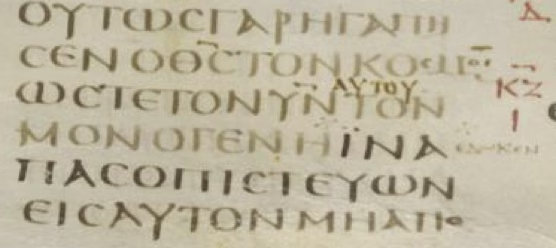
The Greek uncial lettering (i.e., capital letters), with no spaces between the words, is challenging to the untrained eye, but in English it reads, “For God so loved the world, that He also gave [the] only begotten Son….” Uspensky noted, and we can see it for ourselves: “The pronoun, ‘his’ [αὐτοῦ], is omitted here. Why? In order to accustom readers and hearers of the Gospel to the belief that the Son is not consubstantial with the Father.” A correction has clearly been inserted above the line of text.
When we look closely at the image of John 3:16 we can see that two more corrections have been made. They are not relevant to the main argument but they do exemplify the poor quality of the text. First, the verb ἔδωκεν (he gave) is missing but added to the side by a corrector. Leaving out a verb is what we might call a “schoolboy error”’ and renders a sentence meaningless. Secondly, there is a grammatical error. The word for “world” has been given an ending that I am told does not exist in New Testament Greek grammar! It too has been corrected in the margin at a later date. In this one verse a pronoun is missing, a verb is missing, and a noun is grammatically incorrect.
John 5:25-27.The words “so hath he given to the Son to have life in himself” are missing. Why? “To impress upon readers that the Son has no life in himself… But this smacks of Arianism.”
John 6:45-46.We know v.46 to read, “Not that any man hath seen the Father, save he which is of God, he hath seen the Father.” In Sinaiticus the ending of that verse reads, “he which is of God, he hath seen God.”
Uspensky comments,
A remarkable change to the original text! He who is from the Father sees God in Him. Therefore, the Father is his God. What does this mean? It reeks of Arianism. Let us read the original text: “He which is of God hath seen the Father.” This is a different doctrine! The Son, begotten of God, and therefore himself God, sees his Father, not his God. This is Orthodox.
John 16:15. Here the words “All things that the Father hath are mine” are omitted. Uspensky regards this as the next logical step after all that has gone before. He writes,
If the Son does not have life in himself, if he is a created god, if also his Father is his God, then how could one say that he has all that his Father has? These words of St John are contrary to the doctrine of the Arians; and behold, they excluded them from the Gospel.
John 17:9-10. Here Sinaiticus reads, “I pray not for the world, but for them which thou hast given me, for thine are mine. Thou hast given them to me, and I am glorified in them.” Uspensky comments,
Here is further proof of the systematic alteration of the sacred text! The words of St John are “And all mine are all thine, and thine are mine.” These words, which are also found in the text of Vaticanus, were omitted because they were objectionable to the Arians, who did not accept the catholic Church’s teaching on the consubstantiality of the Father and the Son.
We know that one doctrinal error will lead to another and so, in these six passages of Scripture, it is possible to trace a logical progression of heresy in the Codex Sinaiticus.
Many other errors
Anyone who views the Sinaiticus manuscript online will quickly discover that, as regards errors and omissions, these six passages are by no means exceptional. It is fair to say that the codex is riddled with them. Here are just a few more examples, confining ourselves to missing words:
- Ephesians 1:1 “in Ephesus” missing
- Ephesians 6:10 “my brethren” missing
- 1 Thessalonians 2:13 “in truth” missing
- Hebrews 4:9 “There remaineth therefore a rest to the people of God” missing
- Hebrews 8:12 “and their iniquities” missing
- Revelation 1:11 “what thou seest” missing
- Revelation 4:3-4 “in sight like unto an emerald. And round about the throne were” missing
- Revelation 5:1 “a book written” missing
- Revelation 6:1 “the seals” missing
- Revelation 22:18 “shall add unto him” missing
This is just a very tiny sample. These errors, and all the others corrected in the manuscript, were either committed by the copyist himself, or he was copying from a defective text. Either way, it means that a manuscript so praised by modern translators as being amongst the most reliable is in fact corrupt. With errors of this kind, the text would have made no sense at all to someone trying to read it, and it could never have been used in church services. If truth be told, it is difficult to know to what use it could possibly have been put.
Kevin McGrane’s personal view is that Codex Sinaiticus was a private commission by a wealthy individual who wanted it to adorn his library. “It was likely put together by a secular scriptorium in Egypt from defective sources. Fidelity was not of paramount importance; the size and fineness of the parchment were – the outward look and feel of the thing.11” He concludes that the manuscript, “was never a production by the Church for the Church. And we should never be using it in the Church.12” This is in line with Uspensky’s own description of Sinaiticus as “the work of barons,” as we will see shortly. In other words, he saw it as a secular work. He did not believe it had been produced by the church because no church copyist would have made such errors13.
Letter #2
The purpose of the second letter is to ask Tischendorf for the return of a borrowed manuscript, but it gives Uspensky further opportunity to expose the corruptions of the Sinai Codex. He introduces us to what is known as the “Alexandrian family” of New Testament manuscripts, so-called because they originated from Alexandria, a city on the Mediterranean coast of Egypt and geographical source of Arianism. Arius (AD 256-336) himself had been a presbyter in the city.
The Alexandrian text family includes both Codex Sinaiticus and Codex Vaticanus, described by Uspensky as “suspect and faulty brothers.” As for Codex Sinaiticus, he says, “we greatly fear that this treasure might turn out to be ashes.14” In his letter Uspensky also refers to five ancient New Testament manuscripts in his own possession. These belong to another text family, the Byzantine, and it is manuscripts from this family that were used to construct the Received Text.
Uspensky draws our attention to inconsistency within the Alexandrian family of texts, in contrast to the Byzantine texts. He writes,
In general, all the texts of the New Testament of the Alexandrian family differ greatly from each other. How can such great differences be explained? It is obvious to me that they are the work of barons, each of whom has his own imagination. The Church possesses the truth! The Church’s codices are authentic!15 This is the foundation of my faith! This is the anchor of my salvation! Fortunately, I have five ancient manuscripts of this family containing the New Testament. Their verbatim coincidence is astonishing, even though they were written in different places at different times — one, for example, in Thessaloniki in 835, another in Constantinople in 1145, and a third in 1272. This coincidence would be incomprehensible if we didn’t know its cause. But we know that the sacred text was preserved by the love of universal Christians, a love that has its own intelligent ear. We know this and understand well how this text was preserved intact in the universal church while heretics interpolated and corrupted it, each to suit their own taste.
I reject all codices of the Alexandrian family because they are found only in libraries, because their origins are obscure, and because they contradict each other. Their antiquity is no proof of truth. The devil is more ancient than anything in the world, yet he is the father of lies. The indisputable proof of truth is unity, identity. If two or three sacred texts are similar, identical word for word, they contain the words of the apostles, inspired by the Holy Spirit. Such are the aforementioned texts [i.e., the five in his possession].
Both these letters represent Uspensky’s mature thought, having been written 14 years after his intensive study of the text, and his arguments are sound. Unlike Tischendorf, he was not going to be carried away by the apparent antiquity of the manuscripts. It is with a keen spiritual perception that he remarks, “their antiquity is no proof of truth,” but many today have still to learn that basic lesson. The praise heaped upon Codex Sinaiticus by modern evangelical scholars should cause us great concern.
Narrative
The general and rather obvious point to make first is that the narrative presented here is not the one that has dominated New Testament text and translation practice over the past 150 years. It is the narrative of Tischendorf and “oldest is best” that has won the day in the minds of experts and in most Bible societies, resulting in the multitude of faulty Bible translations we have today. The fact that these translations are based on a corrupt text, and that the corruptions have been known about since 1850 and are clear for all to see in the digital codex, ought to shock the many Christians who use them. Modern translators are being, at best, disingenuous, and at worst deceitful.
Have the errors and corruptions in Sinaiticus found their way into modern translations? In the English Standard Version, the New American Standard Bible (1995) and the Legacy Standard Bible, John 1:18 is pure Sinaiticus, all having adopted the reading “God” in the place of “Son.”16 Other popular versions have adopted corrected readings in all of the six passages from John, but this in itself creates an insurmountable problem for Critical Text advocates. Translators who want to claim they are using the oldest text must use the original uncorrected Sinai text with all its absurd, corrupted readings. If they use the corrected readings – bearing in mind that palaeographers have determined the corrections to have been made over hundreds of years – they cannot still claim to be using the oldest text. They cannot have it both ways. Kevin McGrane comments,
But they pick and choose: when it suits them, they accept the original reading, when it doesn’t, they don’t and yet claim that a corrected reading (which might go on to be corrected again hundreds of years later) is the Sinaitic text. But there are 7 or so phases of correction across as many centuries, and they do not accept any particular one corrector as the authentic correction, but pick and choose among them, sometimes the first corrected text, other times the third corrected text, and so on.
In other words, they are picking and choosing readings that suit themselves and their presuppositions. They are doing an eclectic reading of the Sinaitic text to make their eclectic text!17
There is a rich irony in these words of McGrane: “The corrections incrementally brought the text more and more into a Byzantine shape. The final document, with all the corrections added, is distinctively Byzantine.”18
Providential preservation
In Codex Sinaiticus we have a text that is littered with basic grammatical errors and omissions, as well as contaminated with heretical bias. Let us ask the question, Is it the product of providential preservation, the object of God’s singular care by which He has kept the Scriptures pure in all ages? It is self-evidently not the case. In a sense, whether Sinaiticus dates from the fourth century or the seventh century matters little, because it is a corrupt text.
Let us remind ourselves of what the doctrine of the providential preservation of Scripture means. God’s Word itself tells us, “the word of the Lord endureth for ever” (1 Peter 1:25). The Westminster Confession of Faith frames it in these terms: “The Old Testament in Hebrew … and the New Testament in Greek … being immediately inspired by God, and by his singular care and providence kept pure in all ages, are therefore authentical” (WCF I. viii). God has made a promise, but we are to understand that it is not the preservation of manuscripts that He promises, it is the preservation of the text, and the two are very different. In the Sinai Codex we have a very ancient and beautifully preserved parchment manuscript, but a corrupt text, and it is the text that matters.
In this article we have only dipped our toes into the provenance and character of Codex Sinaiticus. So much more could be said, but hopefully there is enough here to sound a warning and give readers cause to check whether the Bible they are using has been influenced by it in any way. Perhaps we see a marginal reference that says something along the lines of “The best manuscripts omit…” or “The oldest manuscripts have…”, or even the more benign “Some manuscripts have …”, or “Other ancient authorities have …”. We are likely to be left confused and puzzled as to what exactly is the Word of God. Our confidence in Scripture is undermined, and our trust in God Himself is weakened.
It is easy for us to be overawed and intimidated by the voice of experts, but it is not to experts that our Lord has given the Word. “I have given them thy word,” prayed Jesus (John 17:14). He has given it to believing fishermen like Peter, tax collectors like Matthew, tradespeople like Lydia, and to you and me. So be warned! Let no one deceive us! We do not need to wait with bated breath for the latest edition of the text from the Institute for New Testament Textual Research to know what the Word of God is, as though it has changed over the past five years or so and our Bibles need to be updated. No, we believe that the Lord gave the Word and that He has kept it, because He Himself has told us so. May our concern always be to hear, to hold in our hands and read, the Word of God that He, by His singular care and providence, has kept pure in all ages.
Footnotes
- The usual number given is 129 but having studied Tischendorf’s scholarly works in Latin and his personal correspondence, Mr Kevin McGrane of Bury St Edmunds has found the true number to be either 116 or 117. I am greatly indebted to Mr McGrane for drawing my attention to Uspensky’s letters, his translation of them, and for his invaluable help in preparing this article. For many years he has researched Uspensky and the Codex Sinaiticus in depth. Some of his work can be found on the website of the Protestant Truth Society, including a lengthy critical review of Dr W. R. Cooper’s The Forging of Codex Sinaiticus. I highly recommend it. ↩︎
- However, “Uspensky’s description of Codex Sinaiticus, including colour plates of it, based on his inspections of it in 1845 and 1850, most especially of its New Testament that Tischendorf had never seen, had been lodged in European libraries, including the British Library, well before Tischendorf set sail for Egypt in 1859 in hopes of finding it.” Kevin McGrane, The Simonides Affair – The Russians Investigations, p. 14. https://protestanttruth.com/wp-content/uploads/2024/09/The-Simonides-Affair_01.pdf ↩︎
- Jürgen Gottschlich, The Bible Hunter (London: Haus Publishing Ltd., 2013), p. 105. ↩︎
- Quoted by Kevin McGrane at https://protestanttruth.com/wp-content/uploads/2018/11/Forging-of-Codex-Sinaiticus.pdf. ↩︎
- Ibid. ↩︎
- Gottschlich, p. 129. ↩︎
- When Uspensky refers to the catholic church he means the church universal, not the Roman Catholic one! ↩︎
- McGrane, op. cit. ↩︎
- Gottschlich, p. 109. ↩︎
- Now known as the Uspensky Gospels. During his travels to the Middle East and Greece Uspensky acquired a number of New Testament manuscripts, currently held in the National Library of Russia. ↩︎
- Personal email. ↩︎
- Ibid. ↩︎
- S. P. Tregelles, on viewing the Codex at Tischendorf’s home in 1862, commented, “the text seems to have been written mechanically by a very ignorant person.” Timothy C. F. Stunt, “Some unpublished letters of S. P. Tregelles Relating to the Codex Sinaiticus,” Evangelical Quarterly, 1976, pp. 15-26. ↩︎
- “Ashes” is an idiomatic expression used in much the same way as we would speak of fool’s gold. ↩︎
- To emphasise the point, Uspensky has written this in Latin: Ecclesia possidet veritatem! Ecclesiae codices sunt authentici! ↩︎
- Interestingly, the latest edition of the NASB, published in 2020, makes some attempt at correction with, “No one has seen God at any time; God the only Son, who is in the arms of the Father….” But “Son” is in italics. ↩︎
- Personal email. ↩︎
- Ibid. ↩︎