
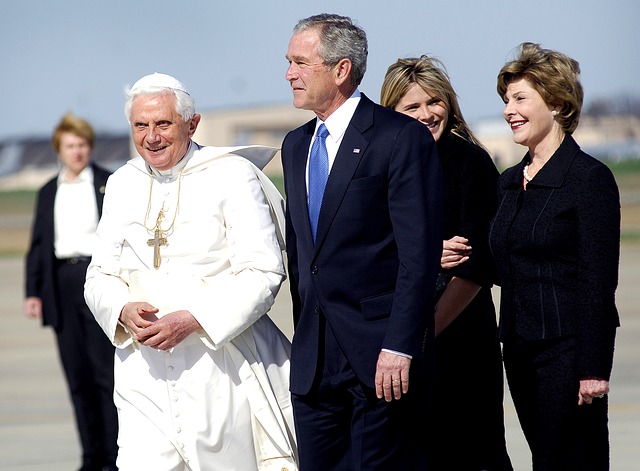
The Pope and the second visit
By J.P. Thackway


Our readers will know that the Pope of Rome (Joseph Ratzinger, otherwise known as Benedict XVI) is to visit the UK on 16-19 September. A papal visit happened only once before, in 1982. Back then, it was Karol Wojtyła (John Paul II) who came to these shores, from 28 May to 2 June. While here, he conducted masses in six of the seven venues throughout the country: London, Canterbury, Cardiff, Coventry, Liverpool, Manchester, and York. Some of these were huge open-air events, attended by thousands. He did not, however, go to Northern Ireland.
That visit twenty-eight years ago was historic because it was the first since Henry VIII broke with the Roman Church in 1534. It aroused much righteous indignation among God’s people because they correctly viewed it as treacherous to our Protestant heritage in the Act of Succession*, and a sad betrayal of the Queen’s Coronation Oath to “… maintain the Laws of God and the true profession of the Gospel … the Protestant Reformed Religion established by law.”
One pope came and went, and now another will come and go. The passing of almost three decades between these is a large swathe of time. So much has happened in our nation, in evangelicalism – and in ecumenical developments during that period. At the time of writing this the second visit is still pending. However, we can set these two beside each other to compare and contrast them. As we do so, the changes mentioned earlier should become apparent – and they may prove instructive and profitable for us in our day.
1. The character of these visits is different.
Back in 1982 it was stressed that the Pope was not invited by the UK government – it was to be “a pastoral visit.” That is, to minister to the nation’s five million Roman Catholics as their supreme bishop and pastor. Clearly, however, there was more since the Pope is a political figure ruling over Vatican City, the smallest state in the world. This means he makes his foreign visits as a head of state, with due recognition and honours. It would include receptions by the Queen and the Prime Minister – hardly just “a pastoral visit”! In the event, there were meetings and talks behind the scenes and the facade of his ministry to “church members.”
This time round nothing is said about a pastoral visit. In fact, no attempt is made to play down Ratzinger’s incursion upon a land that once loathed papal pretentions. The initial invitation was from the Prime Minister himself (which is a last infamy Gordon Brown may be remembered for). It was reinforced by Prince Charles, who visited the Vatican last April. In addition to meeting the Queen, said one national newspaper, “Benedict will be accorded the full pomp of a state visit and – say sources – may even be invited to stay at Buckingham Palace.” Also, the pontiff is expected to lecture at Oxford University and address both Houses of Parliament. And visit Northern Ireland.
This is a far cry from the supposed pastoral visit of 1982. This time it is openly (because the climate is deemed safe) what papal visits are: a claim to being the supreme head of all Christians, and of all countries. From the earliest times popes have had political pretensions. Boniface VIII (1294-1303), in one of his papal proclamations said, “Listen to the Vicar of Christ, who is placed over kings and kingdoms.” In 1570, Pope Pius V, in a bull (formal written statement) against Queen Elizabeth I, with gross impudence claimed to be “prince over all nations and all kingdoms.”
Ever since Henry VIII’s break with her, Rome has wanted Great Britain back. History shows how many times Rome has tried through political intrigue and military measures, but has failed. In God’s mercy by 1701 and the Act of Settlement, Britain rested upon a Protestant foundation. In later times, and especially since the Catholic Emancipation Act of 1829, Rome has worked from within Great Britain to further its aim. By the mid-19th century, Cardinal Manning, was bold enough to declare openly his, and the Vatican’s, objective regarding our country,
It is good for us, reverend brothers, to be here in England. If ever there was a country in which there is much to do, and perhaps much to suffer, it is here. I shall not say too much if I say that it is for us to subjugate and subdue, to conquer and to rule, an imperial race. We have to do with a will which reigns throughout the world, as the will of old Rome reigned once; and it is for us to bend or break that will, which nations and kingdoms have found invincible and inflexible. Were heresy conquered in England, it would be conquered throughout the world. All its lines meet here; therefore, in England the church of God must be gathered in all its strength. You have a great commission to fulfil, and great is the prize for which you strive. Surely a soldier’s life and a soldier’s heart would choose by institution this field of England for the warfare of the faith.
It is not for nothing that the pope who came in 1982, a fanatical devotee of Mariolatry, referred to England as “Mary’s Dowry.” He hoped to nudge things nearer to that objective then. Afterwards, reflecting upon the event to Rt. Revd Murphy-O’Connor, he said “…that visit to Great Britain was the best of all my visits.” Ratzinger comes decades later, and no doubt hopes his will be even better.
2. Protests from other quarters are now being heard.
Last time the protests seemed to come only from Bible-believing Christians, now it is different. Since then at least two factors have diversified and intensified hostility to the pontiff’s visit this time.
a] The child sex abuse scandals involving numerous priests.
The torrid details of these, going back in some cases to decades, has been comprehensively published in the media. The Lord, who is ever the refuge of the oppressed (Psalm 9:9), and tender toward children (Mark 10:14), has not suffered these abominations to remain secret. In the Irish Republic, the United States, Germany, Italy, Netherlands, Austria and Switzerland the Lord has ensured that “there is nothing covered, that shall not be revealed; and hid, that shall not be known” (Matthew 10:26).
As one writer has trenchantly put it,
The Murphy Report confirmed the scale and extent of the dreadful things that had been perpetrated on innocent children by perverts and brutes masquerading as servants of God. Not only that, but insult was added to injury by the degree to which senior church officials were prepared to go in order to protect the Church and any public disgrace (Ulster Bulwark, April-June 2010, page 2).
Even worse, it has recently come to light that when he was a cardinal in 1985, Ratzinger had apparently blocked the defrocking of an American priest child molester, Stephen Kiesle! Such revelations portray the Pope as the protector of evil paedophiles – hardly the kind of man to welcome to our shores. It seems the Lord is pleased to expose and discredit the Man of Sin and his evil cohorts the nearer his visit to the UK gets.
Things are so bad, that in Scotland there are mixed feelings about the visit even among the RC hierarchy there. Scottish bishops declined an offer for the bones of St. Teresa to come to Scotland last year. Moreover, plans for the Pope to address the Scottish Parliament during his visit have been abandoned.
This could not contrast more sharply with the warm, unqualified welcome his predecessor, John Paul II was given when he came in 1982. Back then, the only ones who protested were Protestant Christians. Now many others are joining the protests.
b] The secular lobby has grown in confidence and vociferousness.
Back in 1982 this constituency was little heard and seemed to count for less. The years, however, have changed this, resulting in a much higher profile for atheists and their agenda. One of these is the impact of evolutionary assumptions. Relentlessly through the entertainment media, in education, by “high priests” like Richard Dawkins, people have learned to abandon belief in God and the felt need for religion and moral absolutes. Science explains and solves everything, so the propaganda goes.
Then, came the “equality and diversity” laws. Although sodomy was decriminalised in 1969, things in 1982 had not run so far as now. It was still a scandal to be found out. Now homosexuals and the immoral generally, are emboldened and shameless because they have the protection of the law. Critics are silenced. The Pope, however, has earned himself a reputation for being a hardliner in areas which fly against the political correctness of the times. One writer has said,
In just four years Benedict XVI has become one of the most controversial pontiffs in history … In 2000, he spoke out against rock music, saying it ‘assumes a sometimes cultic character, a form of worship in opposition to Christian worship.’ He has called the Harry Potter tales a ‘subtle seduction’ that ‘corrupt the Christian faith.’ And in his first year as Pope, he claimed that ‘saving’ humanity from homosexuality was as important as saving the rainforest from destruction. A year later he offended Muslims by quoting a Byzantine emperor: ‘Show me what Mohammed brought that was new and there you will find things only evil and inhuman.’ And this year he risked destroying years of hard work by aid agencies in Africa by claiming that distributing condoms actually spreads Aids.
Ironically, we find ourselves agreeing with some of those sentiments, because, like the devil, the Pope can sometimes say scriptural things. However, just as ironically, it has given God’s people a host of co-protesters that oppose this pope’s visit, albeit for reasons of their own.
The National Secular Society has mounted a protest campaign made up of gay groups, victims of clerical abuse, feminists, family planning organisations and pro-abortion groups, among others. Its President, Terry Sanderson, said,
The taxpayer in this country is going to be faced with a bill of some £20m for the visit of the Pope. A visit in which he has already indicated, he will attack equal rights and promote discrimination. We have a petition online where people can make clear their opposition to the state funding of this visit. If the Catholic Church wishes its leader to come here, it should pay for the visit itself.
In March this year, that petition was handed to Number 10 and it amounted to 28,000 signatures. And, in a glance back to 1982, even the Daily Telegraph’s Catholic commentator, Damian Thompson, agreed in his blog that the visit should be a pastoral visit and not a state visit.
What strange “allies” we now have in deploring and opposing the visit of the Pope in 2010! While we do not look to them, nor even think of co-operating with them, nonetheless the kingdom of darkness is divided against itself and we cannot help thinking this is better than in 1982, when it seemed “all the world wondered after the beast” (Revelation 13:3).
3. We believe it will be, as before in 1982, divinely-overruled.
In 1982 I was a pastor in Devizes, Wiltshire, and I wrote an article in our church magazine about the first papal visit. In it I was able to record some significant ways the Lord had worked, and here are some of these. They encourage us to believe that the Lord will similarly overrule for His glory this time round.
a] There is evidence of a divine control over the affair.
God allowed him to come after all; even though so many, so repeated, and so fervent were the prayers that he might be stopped. Indeed, at one point it seemed that the visit would be cancelled because of the Falklands conflict. However, God chose to answer our prayers His way (Isaiah 55:8,9).
The Pope came, but the Lord’s restraint was upon his coming. Things did not turn out quite as was hoped. Political tension was high because Britain was at war with Argentina. Roman Catholic Argentina’s occupation of Anglican territory put the pontiff in a difficult position. Although welcomed by the Queen, political connections had to be dropped, which meant he did not meet the Prime Minister, Margaret Thatcher – a serious blow. And the Archbishop of Canterbury, Robert Runcie, was persuaded to drop plans for a pontifical Mass at Canterbury Cathedral. Also, an ecumenical pilgrimage to the shrine at Walsingham was not held.
In addition, numbers attending the open-air Masses were lower than expected; I heard from a British Rail employee that many of the extra trains laid on were not used. And, of course, the escalating action in the Falklands – with our troops winning – tended to overshadow the visit and dominate the media. The majority, quite rightly, were eager for news of our men rather than where the Pope had been that day. All this robbed him of some prestige and influence, and not accidentally. We believe that, just like the false prophet Balaam was given space for his wickedness – but only so far – so this arch false prophet did not have things all his way.
b] Those six days revealed where the Roman Church’s authority lies.
Clearly, with itself. In his speeches the Pope covered a range of issues: world peace, human rights, marriage, contraception, abortion, the church, the priesthood, etc. Yet did you hear him quote or expound one verse of scripture to support his pronouncements? The absence of this was most marked. All his utterances were in his own name; he was the only authority. Appeal beyond him and his “church” was never made. This hideous spectacle of unbelievable arrogance solemnly confirms what we knew: that the Romish system is built upon the traditions of men, is not of God, and is a refuge of lies to all who trust it. We are forcibly reminded why it is that we reject it with righteous disgust. What a priceless treasure is the open Bible and the light of divine revelation! It is good that the basic and fundamental difference between Romanism and true Christianity should be made so evident to us – and we trust, to others also.
c] The papal visit gave the UK a glimpse of what popery really is. The mass media, attracted by the man’s acting skills and the crowds’ euphoria, conveyed the usual superficial image. But anyone with any discernment would be unimpressed. In the Pope’s reference to the Falklands conflict, although he described it as “tragic” and called for peace, he cunningly avoided laying the blame for it on the original aggressor: Argentina. Why? Because secretly the papacy was pleased that the Falklands were in the hands of a Roman Catholic country, thus extending its influence – “The Anglican cathedral was the official ‘state church’ until the Argentine invasion put the R.C. church in that position, a change not at all welcome to the majority of Falklanders” (Evangelical Times, May 1982).
This papal duplicity was the same when John Paul II was in the Irish Republic where, although he deplored terrorism, he did not condemn IRA terrorists and refused to excommunicate them from the Church. The papacy’s history is full of such concealed support for any terrorist organisation or totalitarian regime that will help popery gain power over nations. Witness the Roman Church’s deal with Napoleon in the 19th century, and the full support given to Mussolini and Hitler in the 20th century. Bringing things up to date, even the “Protest the Pope” web site gives the following reasons why he should not come in September,
… rehabilitating the holocaust denier bishop Richard Williamson and the appeaser of Hitler, the war-time Pope, Pius XII.
The state of which the Pope is the head has also resisted signing many major human rights treaties and has formed its own treaties (‘concordats’) with many states which negatively affect the human rights of citizens of those states.
The Pope did not come in 1982 as a “friend” or “Chief Ambassador of Peace and Concord.” He came representing popery – unrepentant of its shameful history, and seeking to repeat that history in our country. The Pope is a monster masquerading as a man of peace. We pray that, having betrayed himself a little, intelligent people will beware.
d] Some more home-truths emerged while the pontiff was here.
Remember how the Pope received the worship of young people in Scotland as they sang to him “He’s got the whole world in his hands”? When Cornelius fell down and worshipped Peter, the supposed first pope, “Peter took him up, saying, Stand up; I myself also am a man” (Acts 10:26 cp also Revelation 22:8,9). The Pope, however, did not refuse this divine homage. What idolatry and blasphemy!
Then, surely the spiritual and moral bankruptcy of Romanism was plainly seen. The UK has five million Roman Catholics, many of whom were seen wildly cheering, their head. Nearly 10% of our fellow- citizens follow this man and his church – that should equate to a lot of salt and light. Yet what difference does it make to this ungodly and perverse nation of ours? Hardly any. For Roman Catholicism is largely a religion that has minimal effect on faith and conduct. One prominent RC stated that the Pope was coming to revive Christianity in Britain – but where is the revival? It was a six-day wonder, because Romanism is nothing more than a carnal and worldly thing, despite all its pious and moral pretentions. Souvenirs and trinkets, money-spinning and a good day out were more in evidence than conversion to Christ and vital godliness.
e] Many were the protests, both negative and positive.
We are thankful for what was accomplished: letter-writing, campaigning, public demonstrations (in Glasgow alone 1,200 people marched through the city), evangelism of Roman Catholics and preaching at rallies around the country. I remember attending one such rally on a hot June day in Trafalgar Square in London, addressed by Geoff Thomas and David Samuel. With all this revived exertion for the cause of God and truth the devil may well feel he has overreached himself. The last Day alone will reveal the eternal work that God has done through His servants.
In 1982, through the prayers and witness of God’s people, it pleased Him to work in remarkable ways to offset a blasphemous presence and further His gospel. We pray that in 2010 also, the same will happen in the mercy of the Lord. And that the words of Genesis 50:20 will be fulfilled again,
But as for you, ye thought evil against me; but God meant it unto good.
* “The Act … laid down the conditions under which alone the Crown could be held. No Roman Catholic, nor anyone married to a Roman Catholic, could hold the English Crown. The Sovereign now had to swear to maintain the Church of England (and after 1707, the Church of Scotland)” See www.royal.gov.co.uk.