
Luke’s use of dexiolabos
By Dr. Colin Slater


Make ready … spearmen two hundred, at the third hour of the night; And provide them beasts, that they may set Paul on, and bring him safe unto Felix the governor. Acts 23:23,24
Dr Colin Slater
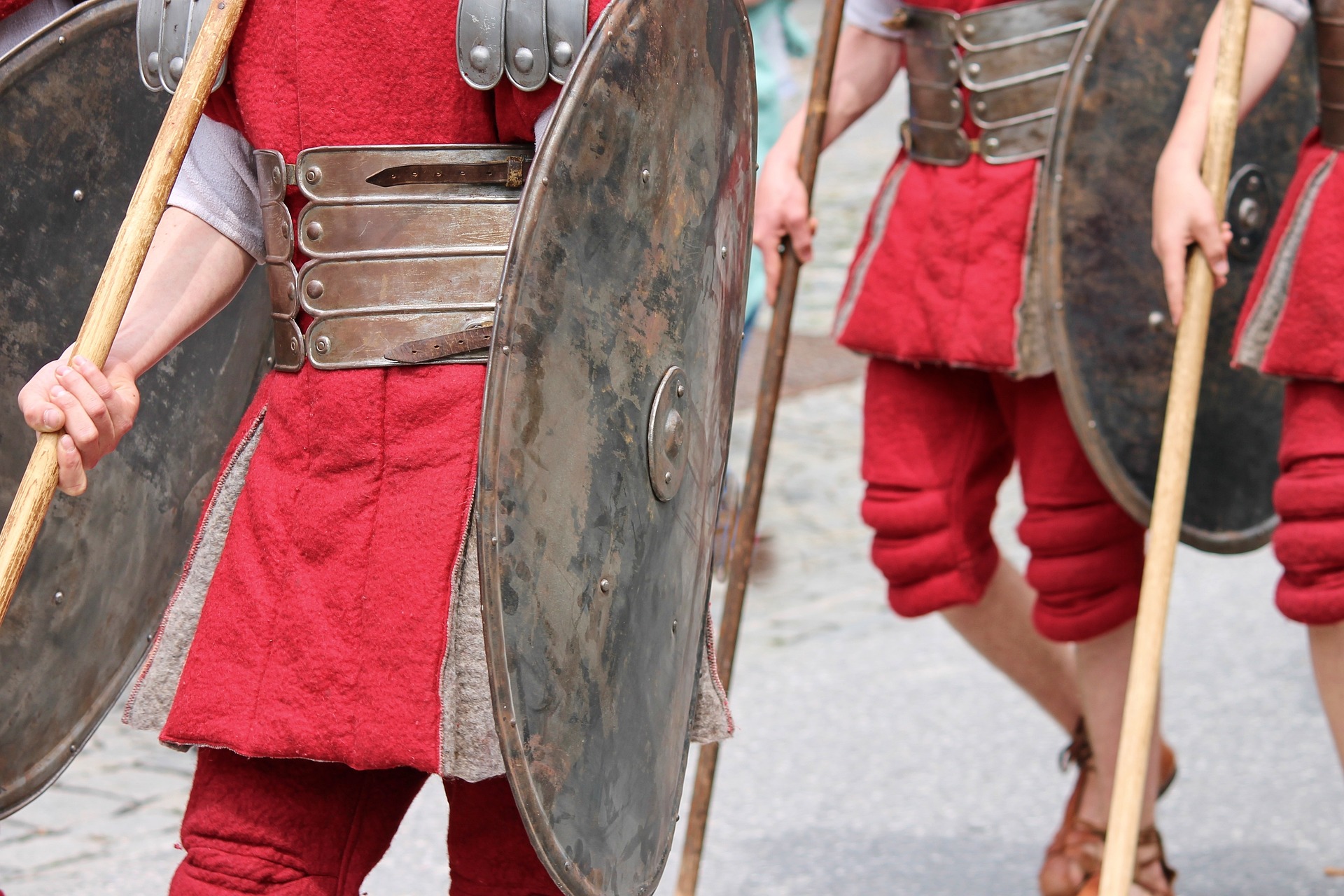
In verse 23 above, a hapax legomenon (a word where only one instance is recorded) is used, which in the Authorised Version is translated “spearmen” (Greek, Dexiolabos).Not only does this word appear in the New Testament only once, but also the dictionaries record that it is found nowhere else in ancient secular literature either. There seems no certainty of its military implications, although dictionaries suggest a technical term of military significance.
The occasion of Luke’s recording this word is the passage where Claudius Lysias, military tribune on duty in Jerusalem when the apostle Paul is rescued from a mob in the temple, transferred him to Caesarea under guard because of threats from forty sicarii (Jewish zealots opposed to Roman occupation) to murder Paul. The Roman military officer conducts himself admirably; a point surely made by Luke. The Greek does not support, in my view, the adverse criticism of Claudius Lysias sometimes alleged.
J F C Fuller, notable military historian of a previous generation, records that where regular armies are pitted against irregular forces, such as guerrillas or insurgents, the regular, uniformed, troops can win provided they operate with a ratio of 12 or 13 to 1. Fuller recorded this, as I recall, as a simple fact of military history. (The relevance of this to international events in our time is both telling, and may witness that our “powers that be” are “willingly ignorant” of more than just Scripture.) Claudius Lysias deploys his troops in exactly this ratio, I calculate 12.7:1, to get his prisoner, Paul, safely away from Jerusalem the city of danger. Their onward journey was then with rapid, mounted troops.
Because the Eastern Mediterranean littoral was a difficult and dangerous assignment for Roman officers, postings there in the cursus honorum (order of public offices) would likely be for young men of known capability and expected to show competence under difficulties. Paul’s rescuer demonstrated considerable military capacity. I believe Luke intentionally demonstrated this. It is consistent with his testimony elsewhere in his writings. It is noteworthy that the centurions, of whom there are several in the Gospels, receive favourable, even honourable, mention too.
Sicarii – assassins of whom the region and world still know – were men who wielded weapons frequently at close quarter, often making their deadly thrust in a throng or press where the victim may even be held up by the press to fall after the assassin had gone and the press of people were released. Such things have been recorded, e.g., on underground trains in our own day. A way of concealing a weapon is to have it on the “wrong,” i.e., the left side of the body and so allay suspicion. Consider Ehud in the book of Judges.
The Romans operated by technique. They are famous, not for inventing things themselves, but adapting known developments of others and establishing them in a modus operandi that made them routinely effective. They would have adapted military techniques to counter the known threat of sicarii with which the region was infested. Roman soldiers were drilled in the movements, actions, and operations they were expected to perform on the battle field. It is likely the Roman military developed a routine technique, and trained bodies of troops to carry out particular actions to counter sicarii. If these opponents operated by coming from their left side the technique to deal with them may have been to “take them on the right: dexio – laboi, this unique word: “spearmen.”
Dexiolabos is compounded from dexios, right-hand and lambano, “I take.” It could mean, taken or received on the right. If sicarii used a left-handed technique or concealed weapons on their left side then “taking them on the right” somehow would be a reasonable fighting manoeuvre. (This is reminiscent of the Far-Eastern assassin’s larang, a blunt, cross-shaped implement used to strike the abdomen over the spleen which in populations where splenic enlargement is endemic would cause fatal internal haemorrhage from the ruptured spleen.)
Luke’s use of this unusual word may indicate his knowledge of Roman military routine and training, and suggest another example of how the Roman army adapted to local conditions. This may be more evidence of doctor Luke’s expertise as an historian.